Contracts
What is a Contract?
A contract lets you buy a fixed amount of hashrate for a fixed period of time, delivered to your chosen mining pool at a price agreed up front. Unlike a spot bid — which competes in the live order book and delivers a variable amount of hashrate only while it stays matched — a contract guarantees a set speed for its entire duration.
Contracts are the right choice when you need predictable, guaranteed capacity: covering a defined period, planning your costs in advance, or securing hashrate without having to watch the market.
Contracts vs. spot bids
How a Contract works
- Define the contract — speed, duration, and destination pool.
- Review the quote — it shows the hashrate cost plus the fee (see Pricing).
- Confirm — the funds needed for the initial part of the contract (currently 3.5 days of delivery) are reserved from your balance.
- Delivery runs for the agreed term, sending hashrate to your pool.
- Settlement happens daily against the hashrate actually delivered.
- A daily reservation tops up the locked funds so the contract always keeps enough runway to keep delivering.
- The contract completes at the end of its term. You can also cancel it early (a reservation fee may apply — see Canceling a contract).
Contract hashrate has delivery priority — a contract keeps receiving its agreed speed regardless of spot-market competition.
Creating a Contract
Test your target on the spot market first. Before committing to a contract, place a small spot bid pointed at the same pool URL and worker, and confirm hashrate is delivered and accepted as expected. Automatic pool validation catches most problems, but it isn't foolproof — and discovering an incompatibility only after the contract has started would mean canceling it and paying the reservation fee.
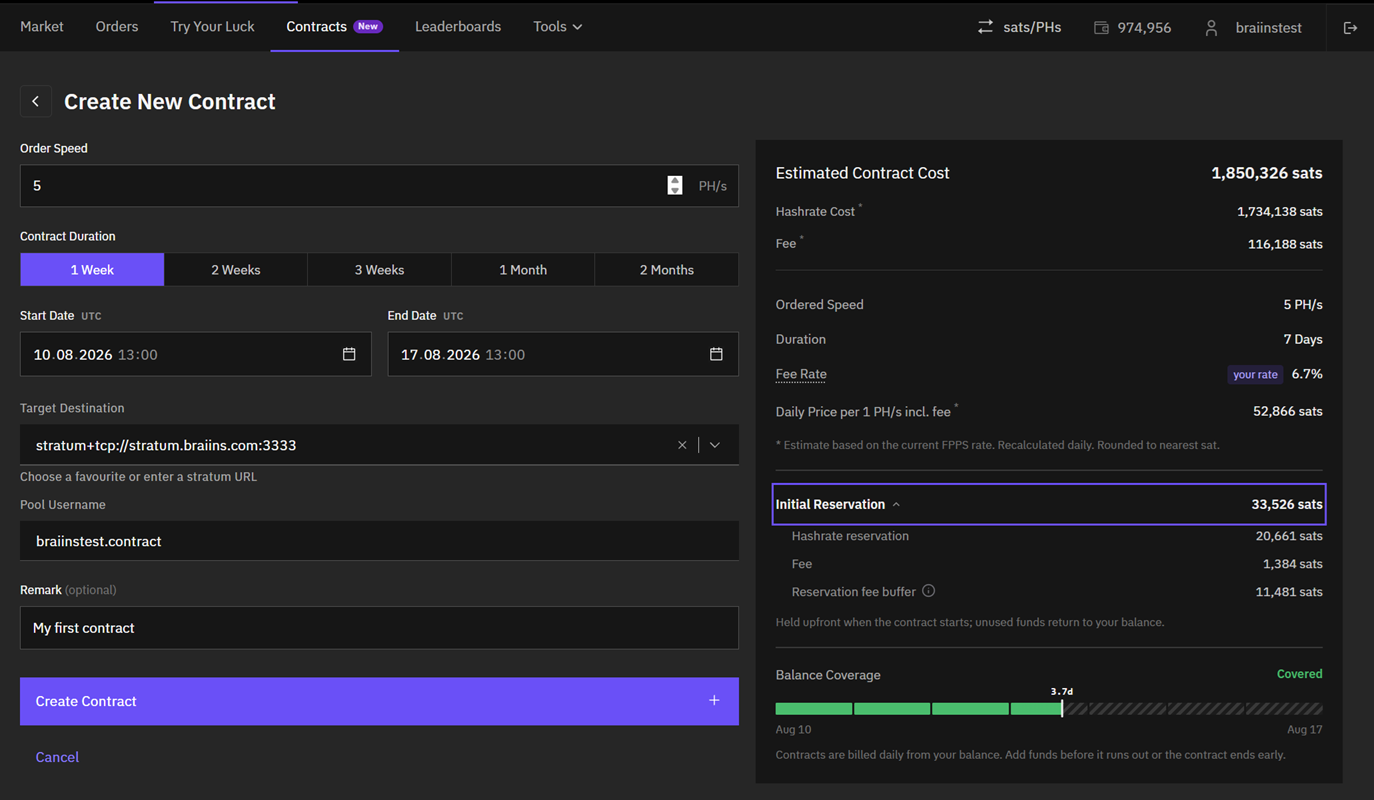
Open the New contract dialog from the Contracts tab and set the contract's parameters:
As you adjust the speed and duration, the price updates automatically so you can see the effect before committing.
The same pool compatibility rules as spot bids apply — your pool must support extranonce2_size >= 7. See Pool Compatibility for details.
Before the contract is created, you confirm it via Telegram 2FA — just like spot bids. The contract is only placed once you approve the prompt in Telegram.
Contract parameters
Understanding the quote
Before you confirm, the contract shows a quote — a pricing estimate for the whole contract, plus the amounts locked from your balance up front: the initial reservation and the reservation fee buffer.
Because the hashrate cost tracks the FPPS rate, which changes daily, the totals are an estimate: the amount actually settled depends on the FPPS rate on each delivery day. The fee percentage is fixed for the life of the contract (see Pricing).
Pricing
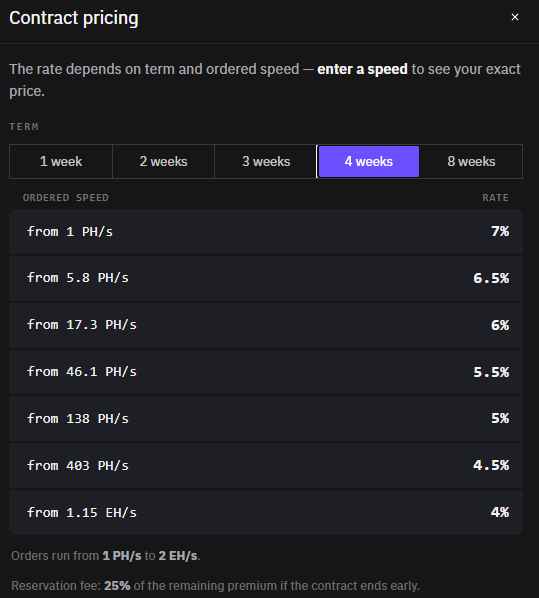
Your contract price is the hashrate cost plus a fee. The fee is our premium on top of the FPPS rate — the pay-per-share rate that sets the underlying hashrate cost. It is shown as a percentage and follows a volume discount: the more a contract delivers overall (speed × duration → total shares), the lower the percentage. A short, small contract pays a higher rate than a large, long one.
The fee rate is frozen when the contract is created and stays fixed for its entire term. Any later changes to our pricing do not affect contracts that are already running.
Pricing is based on the total number of shares a contract will deliver, which is a function of both speed and duration — so a longer or faster contract earns a lower fee percentage.
The terms shown in the pricing window are only examples for the most common durations. Once you enter your exact contract duration, you'll get customized speed brackets.
Contract list
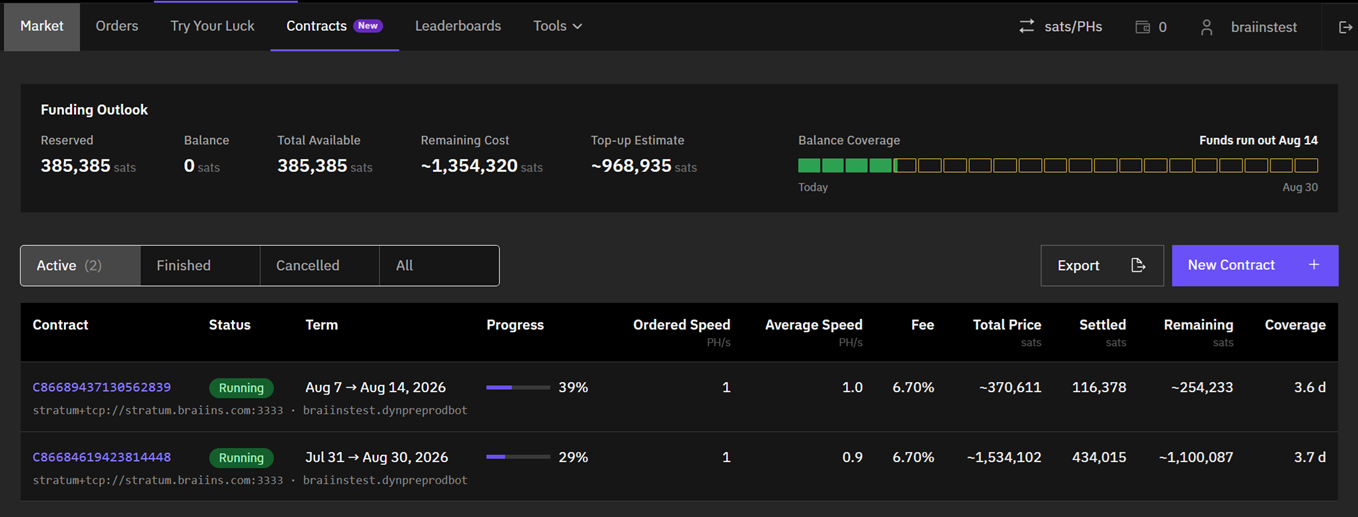
The Contracts tab shows a funding outlook for all your contracts, followed by the contract list.
Funding outlook
A summary of how well your contracts are funded:
- Reserved — funds currently reserved across all your running or scheduled contracts
- Balance — your available balance
- Total available — the sum of the two above; the maximum funds available for your contracts
- Remaining cost — an estimate of how much is needed to cover the yet-unsettled cost of all running or scheduled contracts
- Top-up estimate — the estimated amount to deposit in order to fulfill all running or scheduled contracts
- Balance coverage — a graphical view of your daily coverage
With multiple contracts, or gaps between them, the balance-coverage graphic can sometimes be confusing to read.
Contract list
For each contract the list shows:
- Contract ID — unique contract identifier
- Status — the contract's current status
- Term — how long the contract runs
- Progress — how much of the term has been delivered
- Ordered speed — the contracted hashrate
- Average speed — the actual average hashrate delivered so far
- Fee (rate) — the fixed fee percentage applied to the contract
- Total price (estimate) — the estimated all-in cost (hashrate cost + fee)
- Settled amount — how much has been settled (paid) so far
- Remaining (estimate) — the estimated cost still to be settled
- Coverage — how much of the contract's remaining cost is currently covered by reserved funds
From the list you can create a new contract or open a contract's detail — there is no cancel action here.
Contract detail
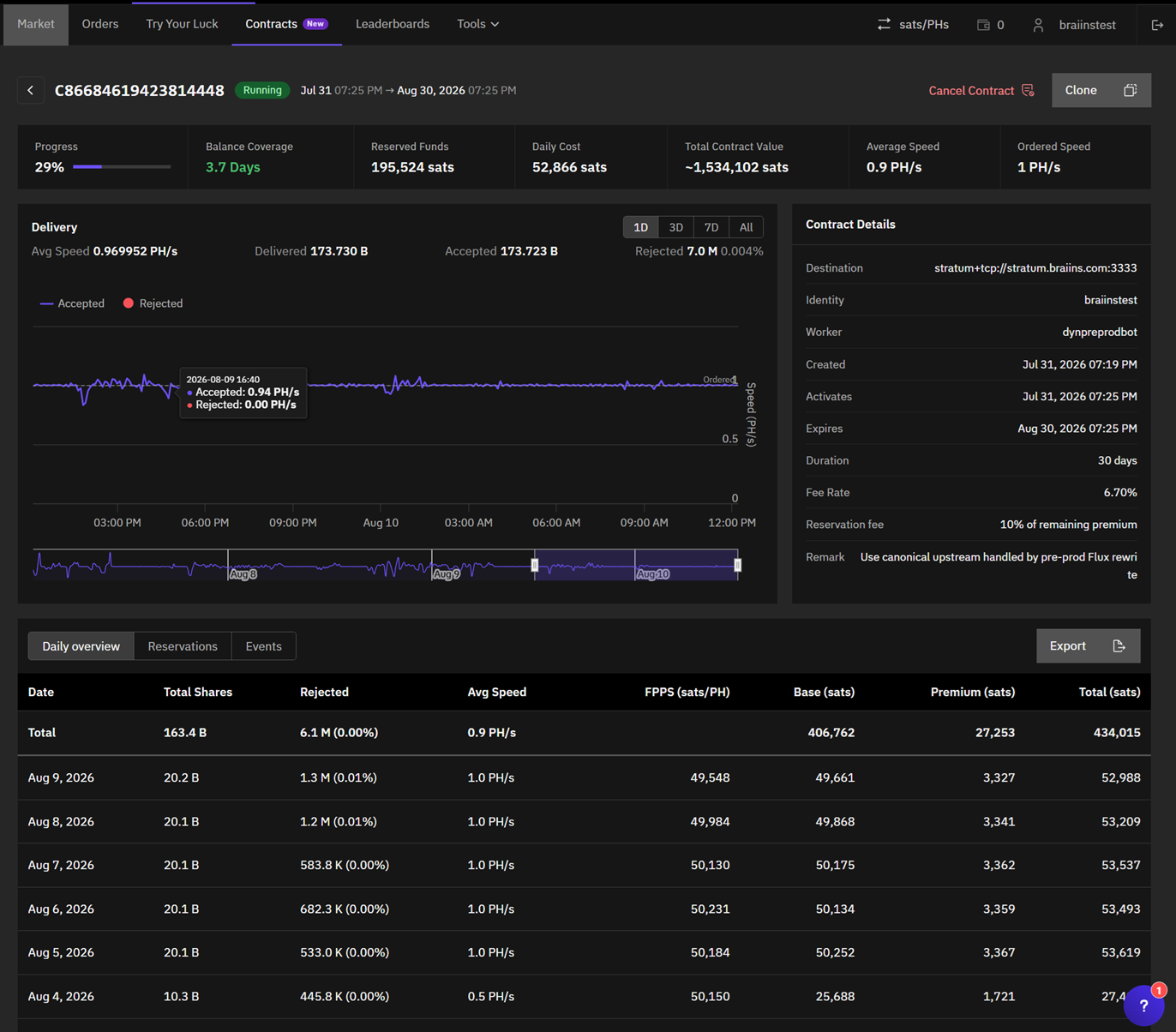
Selecting a contract opens its detail view, organised into four sections.
Overview
Key metrics for the contract at a glance:
- Progress — how much of the term has been delivered
- Balance coverage — how much of the contract's remaining cost is currently covered by reserved funds
- Reserved funds — the amount currently locked on the contract
- Daily cost (current) — the current estimated cost per day at the latest FPPS rate
- Total contracted value (estimate) — the estimated all-in cost over the whole contract
- Average speed (overall) — the actual average hashrate delivered so far
- Ordered speed — the contracted hashrate
Delivery chart
Hashrate delivered over time.
A longer chart span uses longer time slots, which smooths out the short-term oscillations in delivery.
Contract details
The parameters used to create the contract — speed, duration, start, destination pool and worker, and the agreed fee.
Daily overview
A day-by-day breakdown of settlements, reservations, and contract events. The daily overview can be exported.
Funds & settlement
Contracts are funded from your available balance and settled as they deliver.
Initial reservation
When you create a contract, the funds for its initial period — currently the first 3.5 days of delivery — are reserved (locked) from your available balance, with the fee for that period prepaid. The reservation fee buffer for the rest of the contract is reserved as well (see Understanding the quote). The remaining delivery cost is not locked all at once — it is reserved over time as the contract runs.
Daily settlement
Once a day, the previous day's delivery is settled: the hashrate actually delivered is charged (hashrate cost + fee) and drawn from the locked funds. Settlement runs at 02:00 UTC — it needs the previous day's FPPS rate to be final first, so it cannot run at midnight.
Keeping the contract funded
After settling, the system tops the reservation back up toward its full target (currently 3.5 days of runway). If your available balance can't cover the full top-up on a given day, the system keeps looking for funds continuously and reserves them as soon as they arrive — so topping up your balance refills the contract automatically.
Auto-termination
If the funds on a contract fall below a safety threshold — currently enough to cover the next 2 hours of delivery — the contract is terminated immediately. Keep enough available balance so the daily reservation can maintain the contract and avoid an early end.
Canceling a contract
You can cancel a contract before it finishes. What happens — and how quickly your funds come back — depends on whether delivery has already started.
Before the contract starts (not yet delivering): the contract is canceled, the reservation fee is charged, and the remaining reserved funds are released back to your available balance right away.
After delivery has started:
- Delivery winds down — it takes a short time for hashrate to fully stop.
- The hashrate already delivered is settled as normal.
- A reservation fee applies to the undelivered part of the contract (charged from the reservation fee buffer).
- The remaining funds are released on the next settlement, not immediately.
Limitations
Braiins Hashpower is currently in BETA. While we strive for reliability, outages, performance issues, or bugs may occur.
- Pool compatibility: the same requirements as spot bids apply — see Pool Compatibility.
- Delivery momentum: hashrate delivery has inherent latency. Ramp-up takes some time at the start of a contract, and delivery slows before fully stopping at the end or on cancellation.
- No low-balance notifications yet: the platform does not currently alert you when a contract is running low and needs a deposit. Keep an eye on your funding to avoid auto-termination. Notifications are planned for a future release.