Solo Mining
The "Try Your Luck" feature on Braiins Hashpower allows you to quickly purchase hashrate for solo Bitcoin mining, giving you a chance to find an entire block reward.
What is Solo Mining?
Solo mining means mining Bitcoin independently without sharing rewards with a pool. When solo mining:
- You keep the entire block reward if you find a block (currently 3.125 BTC + transaction fees)
- You receive nothing if you don't find a block
- High variance: Long periods without rewards, but potentially large payouts
Solo mining is essentially an ongoing lottery where your hashrate determines your number of "tickets." It is typically pursued by miners with low-powered hardware, where regular pool mining would not be profitable anyway.
Solo Mining vs Pool Mining
Try Your Luck Feature
Braiins Hashpower includes a "Try Your Luck" feature that simplifies solo mining through the hashrate marketplace. Instead of setting up your own solo mining infrastructure, you can purchase hashrate that mines directly to a solo mining destination. The best part is that you can try your luck with much higher hashrate than you could afford to own.
Context
To put the odds in perspective:
- Operating a Braiins Mini Miner (~1 TH/s) for an entire year gives approximately 0.005% chance of finding a block. At the time of writing, this is roughly equivalent to spending $15 on "Try Your Luck."
- If you spend $10 per week on Try Your Luck, your yearly chance of finding a block is approximately 0.17%.
Lottery Comparison
How does Try Your Luck compare to traditional lotteries? Assuming ~$500/year spend:
Finding one Bitcoin block takes roughly 1,000x fewer years than winning a lottery jackpot, though the prize is smaller.
For similar-sized prizes (~$300K), the comparison is even more striking:
Try Your Luck offers 200-340x better odds for a comparable prize.
Solo Mining Tiles
The Market View displays pre-configured solo mining options:
Prices and chances shown are approximate and vary with market conditions.
You can also configure a custom tile with your own budget amount.
Visual Indicators
Solo mining bids have distinct visual elements:
- Gradient backgrounds on tiles for easy identification
- "Solo" badge indicator on bid listings
- Block find probability displayed in real-time
- Best share found shown for active and historical solo bids
How It Works
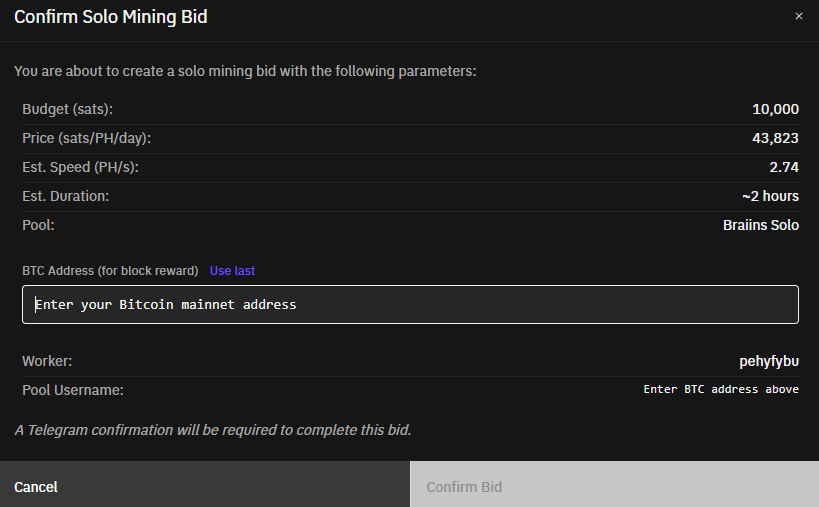
Solo Mining Bid Flow
- Select Budget: Choose from pre-configured amounts or create a custom bid
- Enter BTC Address: Provide your Bitcoin address where block rewards will be sent.
Use lastto repeat last address. - Automatic Configuration: The system configures everything else automatically
- Telegram Confirmation: Confirm the bid via 2FA
- Hashrate Delivery: Purchased hashrate is directed to solo mining
- Block Monitoring: Watch for block discoveries during your session
Behind the Scenes
When you create a solo mining bid:
- You provide only your BTC address — the system handles the rest
- A worker suffix is auto-generated for tracking
- Hashrate is sent to solo.braiins.com (Braiins Solo mining endpoint) where you can validate the delivery
- Speed limit is set for an approximate duration of 2 hours
- Price is set one tick above the top of the orderbook (1 sat/PH/day) to ensure fast matching
- If a block is found, the reward goes directly to your BTC address
- After the budget is exhausted, the session ends
Since the price is set one tick above the current top bid, your bid may lose priority if the market moves. You can manually update or cancel the bid at any time.
Understanding Your Chances
Probability Calculation
Your chance of finding a block is calculated as:
\text{Chance} = \frac{\text{Total Shares}}{\text{Network Difficulty}}Where:
- \text{Total Shares} = \frac{\text{Hashrate (H/s)}}{2^{32}} \times \text{Duration (seconds)}
- \text{Network Difficulty} = Current Bitcoin network difficulty
Calculation Example
For a 2.8 PH/s delivery lasting 2 hours at network difficulty of 148T:
\text{Total Shares} = \frac{2.8 \times 10^{15}}{2^{32}} \times (2 \times 3600) = 4{,}693{,}865{,}776 \text{Chance} = \frac{4{,}693{,}865{,}776}{148 \times 10^{12}} = 0.00317\%Example Probabilities
These are approximate examples. Actual probabilities vary with network conditions.
The Reality of Solo Mining
- The Bitcoin network has over 1000 EH/s of total hashrate
- Even large solo miners face very low probabilities
- Treat solo mining as entertainment, not investment strategy
Best Share
When solo mining, the platform shows your best share — the highest-difficulty share found during your mining session. This gives you a sense of how "close" you came to finding a block. Best shares are displayed as long as the respective worker is tracked by Braiins Solo.
What is Share Difficulty?
Every hash submitted by a miner has a difficulty value. Most shares have very low difficulty (millions), but occasionally you'll find shares with higher difficulty (billions or even trillions). A share that meets or exceeds the network difficulty would be a valid block.
Difficulty Scale
Share difficulties are measured in standard SI prefixes:
Interactive Scale
Great share - significantly above average.
Interpreting Your Best Share
- M range (Mega): Common shares, nothing special
- G range (Giga): Good shares, above average
- T range (Tera): Excellent shares! Getting close to block territory
- 10T+: Exceptional — within striking distance
- ≥150T: Congratulations, you found a block!
Finding a high-difficulty share doesn't increase your future chances — each hash is independent. But it's exciting to see how close you came!
Creating a Solo Mining Bid
Using Quick Tiles
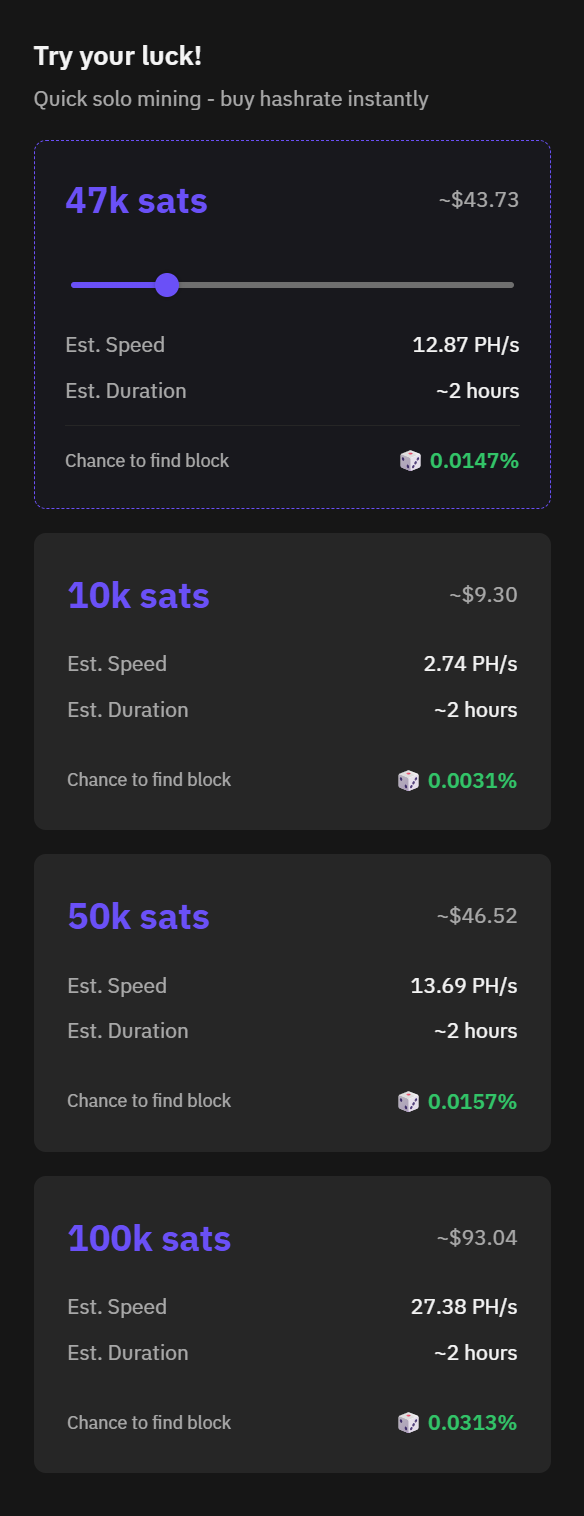
- Navigate to the "Try Your Luck" section (available on Market page, Orders page, or the dedicated Try Your Luck page)
- Click on your preferred budget tile (10k or 50k sats)
- Enter your BTC address where block rewards will be sent
- Review the displayed block find chance
- Confirm via Telegram 2FA
- Monitor your bid in the Orders tab
Custom Solo Mining Bid
You can configure a custom tile with your own budget:
- Click Custom in the Try Your Luck section of Orders tab
- Set your budget (total sats to spend)
- Enter your BTC address
- The system automatically configures price, speed limit, and pool settings
- Confirm via Telegram 2FA
Managing Solo Mining Bids
Solo mining bids work like regular bids — you can:
- Edit the bid to adjust price or budget
- Cancel the bid at any time (unspent budget is returned)
- View bid details including best share found and hashrate delivery
Tips for Solo Mining
- Set realistic expectations: Winning is rare — treat it as a lottery
- Use disposable budgets: Only spend what you're comfortable losing
- Monitor market price: A lower price means more hashrate for the same budget, increasing your chances
- Consider timing: When transaction fees are high, the potential block reward is higher too
- Have fun: The excitement is part of the appeal
- Do it yourself: Create a solo bid manually for full control over price, speed, and duration. Note that the chance to find a block depends only on the total number of shares submitted — whether you mine with 2 PH/s for 10 hours or 20 PH/s for 1 hour, the chances are exactly the same.